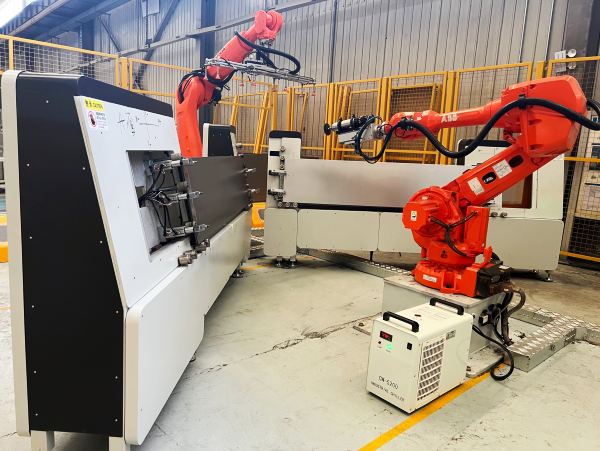
A company's automatic robot polishing project
Project background
In many manufacturing industries, the polishing of product surface is a key process, which directly affects the appearance quality and performance of products. Traditional manual grinding and polishing have some problems, such as high labor intensity, bad working environment and unstable quality. With the development of automation technology and robot technology, it is an effective way to improve production efficiency, product quality and workers' health by using automated robots for polishing.
Second, the project objectives
Improve the surface quality of products
Through the precise motion control of the robot and the setting of polishing parameters, the uniform and smooth treatment of the product surface can be realized, the surface defects such as flaws and scratches can be eliminated, and the appearance quality and surface accuracy of the product can be improved.
For example, in the processing of metal products, robots can control the surface roughness of products in a very small range, making them meet high-precision quality standards.
Improve production efficiency
Robots can carry out grinding and polishing operations continuously and at high speed, which can greatly shorten the processing time compared with manual operation. At the same time, the robot can realize multi-station parallel operation, further improving production efficiency.
For example, in the production of automobile parts, robots can quickly finish the grinding and polishing of complex parts to meet the needs of mass production.
Improve the working environment
Reduce workers' direct contact with dust, noise and other harmful substances and dangerous factors generated during grinding and polishing, and ensure workers' health and safety.
Third, the project implementation content
Robot selection and configuration
According to the size, shape, material and polishing process requirements of the product, choose the appropriate robot type. Generally, multi-axis robots with high accuracy and flexibility will be selected.
Equip the robot with corresponding grinding and polishing tools, such as grinding wheel, abrasive belt, polishing wheel, etc., and install appropriate force control devices to ensure the stability and accurate control of pressure during grinding and polishing.
Programming and path planning
Using professional robot programming software, according to the three-dimensional model of the product and the requirements of grinding and polishing process, the motion path of the robot is planned. Ensure that the robot can accurately cover all areas of the product surface and achieve comprehensive and uniform polishing.
When programming, the characteristics and process differences of different products should be considered, and appropriate parameters such as speed and acceleration should be set to achieve the best polishing effect.
Force control and quality inspection system
A force control system is established to monitor and adjust the force of the robot in the polishing process in real time, so as to prevent the product surface from being damaged due to excessive pressure or the polishing effect from being affected by too small pressure.
Install quality inspection equipment, such as visual inspection system and roughness measuring instrument, to detect and evaluate the surface quality of polished products in real time. If quality problems are found, feedback them to the robot control system in time for adjustment.
System integration and security protection
The robot grinding and polishing system is integrated with other equipment and systems on the production line to realize the automatic cooperative work of material conveying, loading and unloading.
Establish perfect safety protection measures, such as setting up safety fences and installing sensors, to prevent the robot from hurting people during operation.
IV. Expected benefits of the project
Quality benefit
Significantly improve the consistency and stability of product surface quality, reduce the quality fluctuation caused by manual operation differences, and improve the market competitiveness of products.
economic benefits
Improve production efficiency, reduce labor costs and scrap rate, and increase the economic benefits of enterprises. At the same time, due to the improvement of product quality, the added value of products may increase.
social benefit
Improving workers' working environment and reducing occupational health hazards meet the requirements of corporate social responsibility and promote the sustainable development of manufacturing industry.
In a word, the automatic robot polishing project is an important measure to transform and upgrade the manufacturing industry to intelligence and automation, which has broad application prospects and important practical significance.