I. Project background
In automobile manufacturing, the connection technology of automobile body is very important for the strength, safety and quality of the whole vehicle. Traditional connection methods such as welding have some limitations, such as welding may lead to thermal deformation and certain restrictions on materials.
As an advanced connection technology, riveting has the advantages of reliable connection, little damage to materials and adaptability to different materials. With the increasing demand for production efficiency and quality in the automobile industry, it has become an efficient and advanced solution to use robots for body riveting.
Second, the project objectives
Improve riveting quality
Ensure that the installation accuracy and fastening force of rivets meet the standards, so that the connecting parts of the car body have good strength and tightness. Through the precise positioning and force control of the robot, the quality problems such as rivet looseness and dislocation are reduced.
Improve production efficiency
The robot can rivet in a high-speed and continuous way, which greatly shortens the production time compared with manual riveting. It can realize multi-station simultaneous operation and meet the large-scale and high-efficiency production requirements of automobile production lines.
Enhance production flexibility
It can quickly adapt to the riveting requirements of different car types and different body parts, and realize multi-variety and small batch production mode by adjusting the robot's action and process parameters through programming.
Third, the project implementation content
Robot selection and layout
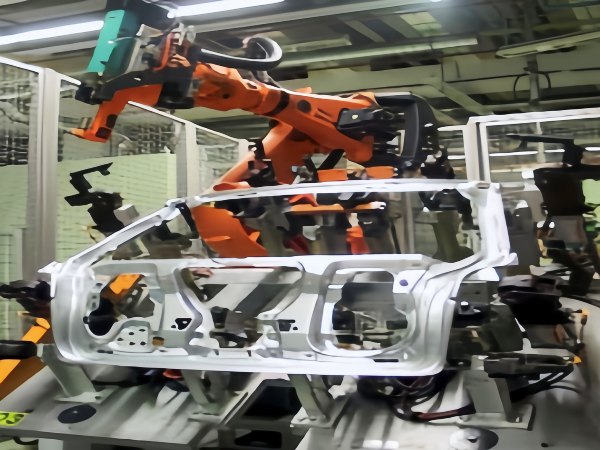
When choosing an industrial robot suitable for body riveting, it is usually necessary to consider the load capacity, working range and accuracy of the robot. For example, a six-axis robot with large working radius and high precision is selected to meet the riveting requirements of different parts of the car body.
The reasonable layout of robot workstations should consider the space limitation of production line, material conveying path and cooperation with other production equipment. Generally, multiple robots will work together to improve the overall production efficiency.
Riveting equipment integration
Equipped with advanced riveting equipment, such as rivet gun and rivet feeding system. The rivet gun should be connected and adapted to the robot arm to ensure that the rivet can be installed to the specified position accurately under the operation of the robot.
In order to ensure the stable supply and correct conveying direction of rivets, the rivet feeding system usually uses a vibrating plate or other automatic feeding devices to convey rivets to the rivet gun in an orderly manner.
Programming and control
Through professional robot programming software, according to the design drawings and riveting process requirements of the car body, the motion program and riveting operation program of the robot are written. Including the robot's trajectory, speed, force and other parameters.
The advanced control system is adopted to realize the precise control of the robot and riveting equipment. For example, the action of the robot is adjusted in real time through sensor feedback to ensure the riveting quality. The control system should also have fault diagnosis and safety protection functions to prevent accidents.
Quality inspection and monitoring
Install quality inspection equipment, such as visual inspection system, force sensor, etc., to detect riveting quality in real time. The visual inspection system can check whether the rivet installation position is accurate and whether there is rivet leakage. The force sensor can monitor the force applied in the riveting process and judge whether the fastening degree of the rivet meets the requirements.
Establish a quality monitoring system to collect and analyze the test data in real time. If quality problems are found, they can report to the police in time and adjust the production process to ensure the stability of product quality.
IV. Expected benefits of the project
Quality benefit
Significantly improve the riveting quality of the car body, reduce the problems of insufficient strength and poor sealing caused by poor connection, reduce the quality risk of the whole car, and improve the reliability and safety of products.
economic benefits
Improve production efficiency and reduce labor costs. Robots can work 24 hours a day, which can greatly reduce production time and manpower input compared with manual riveting. At the same time, due to the improvement of riveting quality, the rejection rate and rework cost are reduced, and the overall economic benefit is significantly improved.
Technical benefit
Promote the technological upgrading of automobile manufacturing process and enhance the competitiveness of enterprises in the industry. Using robot riveting technology, enterprises can better meet the needs of the continuous development of the automobile industry and lay the foundation for future product innovation and production optimization.
V. Development Prospects of the Project
With the development trend of automobile lightweight and intelligence, the requirements for body connection technology will be higher and higher. The technology of robot workstation for body riveting will be improved and innovated continuously, such as developing more intelligent programming algorithm to realize adaptive riveting; Adopt new riveting materials and technology to improve the connection performance. At the same time, this technology is expected to be popularized and applied in other fields, such as aerospace, rail transit and other lightweight structural connections, and has broad development prospects.
In a word, the project of body riveting robot workstation is of great significance for improving the quality and efficiency of automobile manufacturing, and it is an important measure for the automobile industry to develop into intelligent and automatic production.